



Although Texas job growth outpaces the rest of the nation, new research by the US Federal Reserve Bank of Dallas indicates the job market in Texas may be in for a bumpy ride in the near future due to the Trump Administration’s crackdown on immigration.
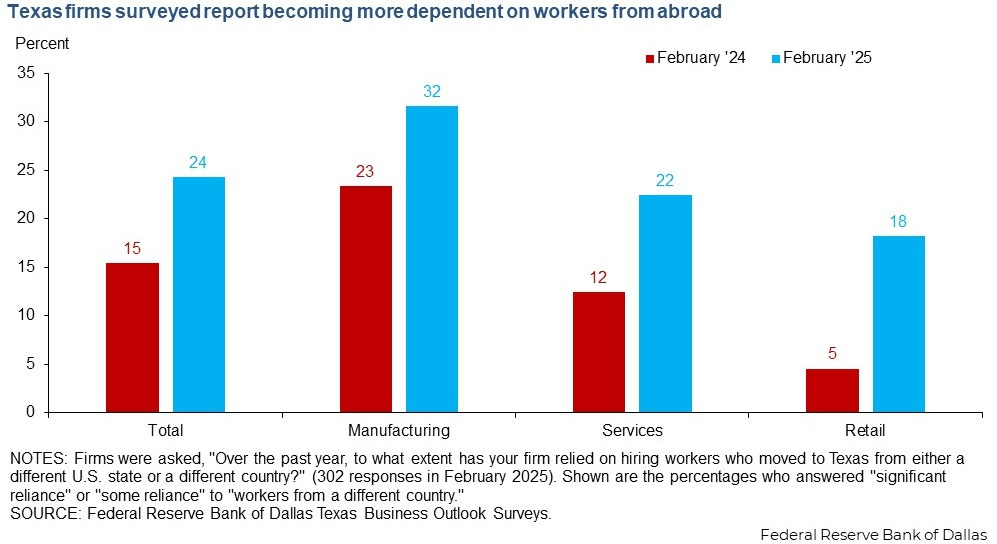
The Dallas Fed notes that Texas firms have grown more dependent on foreign-born workers. The February Dallas Fed Texas Business Outlook Surveys (TBOS) found that roughly a quarter of responding Texas businesses relied on workers from outside the country in 2024. This was a large increase from 15 percent just one year prior.
Legal immigration is slowing as processing times by immigration authorities have increased. In addition, the Dallas Fed notes that “authorities have canceled the refugee resettlement program, intensified background checks, increased fees on visa applicants, and travel bans. These measures have affected legal inflows.”
The Dallas Fed report forecasts that these “immigration policy changes will negatively affect the ability to hire and retain foreign-born workers at one in five Texas businesses this year.”
(The extent of the impact on Texas firms is likely understated because the Texas Service Sector Outlook Survey does not include some sectors that heavily rely on immigrant workers, such as construction and agriculture).
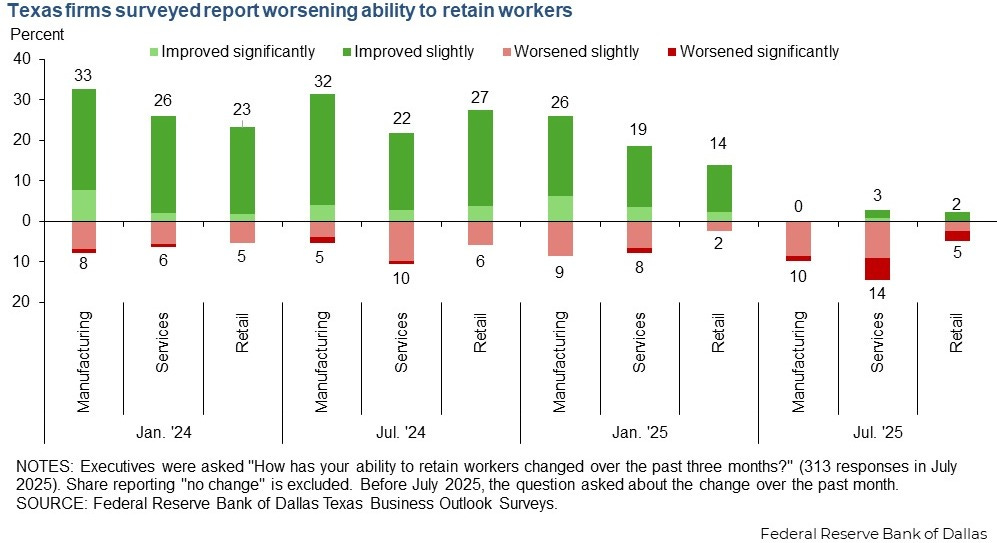
The Dallas Fed notes that “more firms reported a worsened ability to retain workers over the prior three months (13 percent) than an improved ability (2 percent), a sharp contrast to responses over the prior year and a half. The shifting sentiment is notable in the manufacturing, service, and retail sectors.
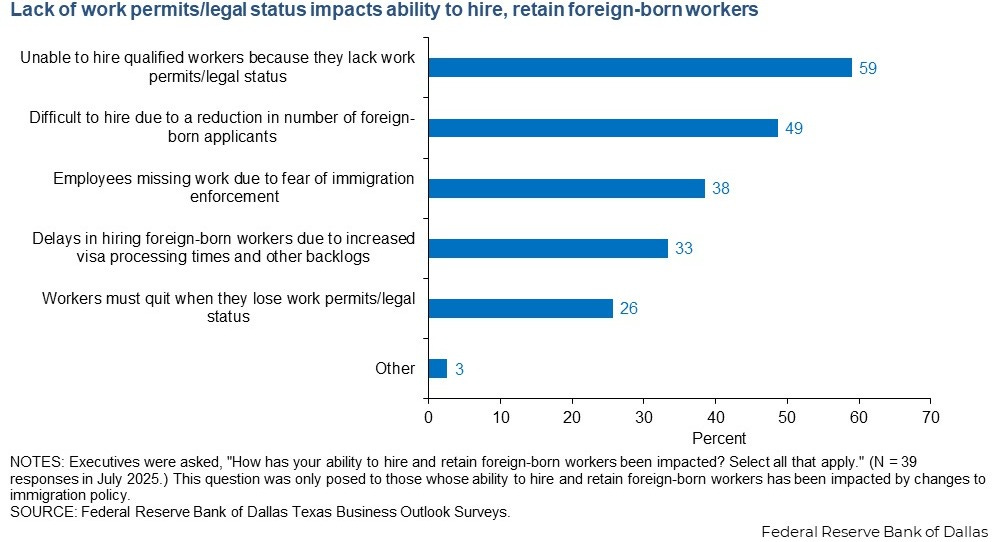
“Among firms affected by immigration policy, about 40 percent indicated employees had missed work due to fear of immigration enforcement. A visitor’s bureau noted, “The hospitality community relies on considerable labor-intensive work—housekeeping, landscape, food and beverage, etc. Workers and contractors are more and more fearful of coming into work in hotels and restaurants.” - Dallas Fed Texas Business Outlook Survey Analysis
Nearly 60 percent of impacted companies reported they were unable to hire qualified workers because such individuals often lack work permits or legal status. Additionally, 49 percent noted difficulty hiring due to fewer foreign-born applicants.
Will existing employees benefit?
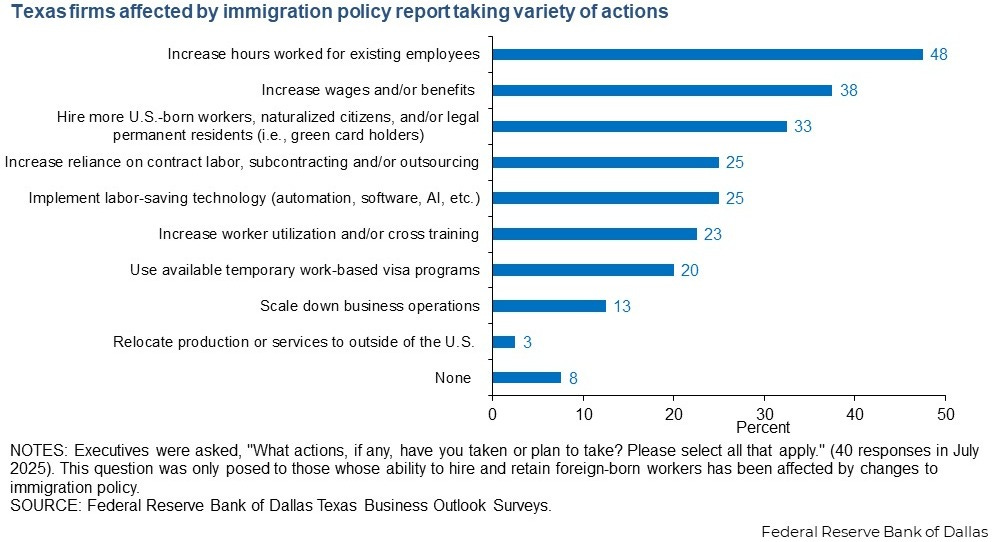
Texas firms are taking measures to address the impact. Chief among them is increasing work hours for existing employees. Other responses include planned wage and benefit increases, as well as more hiring of U.S.-born workers, naturalized citizens, or legal permanent residents.
However, the Dallas Fed cautions that this silver lining for existing workers also comes with bad news for the overall economy:
“Less immigration doesn’t necessarily mean higher or lower unemployment, but it will likely result in slower economic growth. The labor market will show this first in the form of less job growth. Lower GDP growth will eventually follow. The U.S.-born workforce cannot make up for reduced immigration due to demographic pressures, including an aging population and low birth rates.”
- Federal Reserve Bank of Dallas report
How do you believe the immigration crackdown will impact the Texas economy & job market?
Share your opinion in the comments on this article!
NEW FEATURE! Would you like US Border News articles to appear in your Google News feed? Click the button below!
Abrazos,
Jack Beavers


Another good explanation of stuff I didn't know!
At least Americans are being forced to confront immigration policies; better late than never.
Too much abuse of asylum claims, the H1B program being used to replace American talent with indentured foreign workers, and giant ag firms [particularly slaughterhouses] being allowed to skate on labor code violations with illegal immigrant employees, has become untenable.
And perhaps it's long past time we reexamine the administrative burdens imposed on employers [particularly small to midsize farmers] who wish to use legal guest workers seasonally. We used to have a system that worked; now everyone is angry, but nobody has practical solutions.
In fact, googling "hidden costs in guest worker program" reveals a litany of problems in various aspects of foreign labor being described over the past quarter century. This is one of those very complex challenges like healthcare, which are only debated publicly in simplistic hot takes.
I feel bad for my former liberal friends, because it's impossible to square concern for American workers, foreign neglectaroonies' economic opportunities, and union interests at the same time. It's the wobbliest three-legged stool you'll ever see.
Only time will tell if there are indeed certain jobs Americans will not do; changing geopolitical circumstances may force a reshoring of manual labor in many sectors. Despite the polarization of political views, it's economically untenable to hold the world reserve currency and also have a robust export economy, as it was after WWII. China has risen rapidly by suppressing their own currency valuation, but that's socially unsustainable, as they are discovering belatedly.